
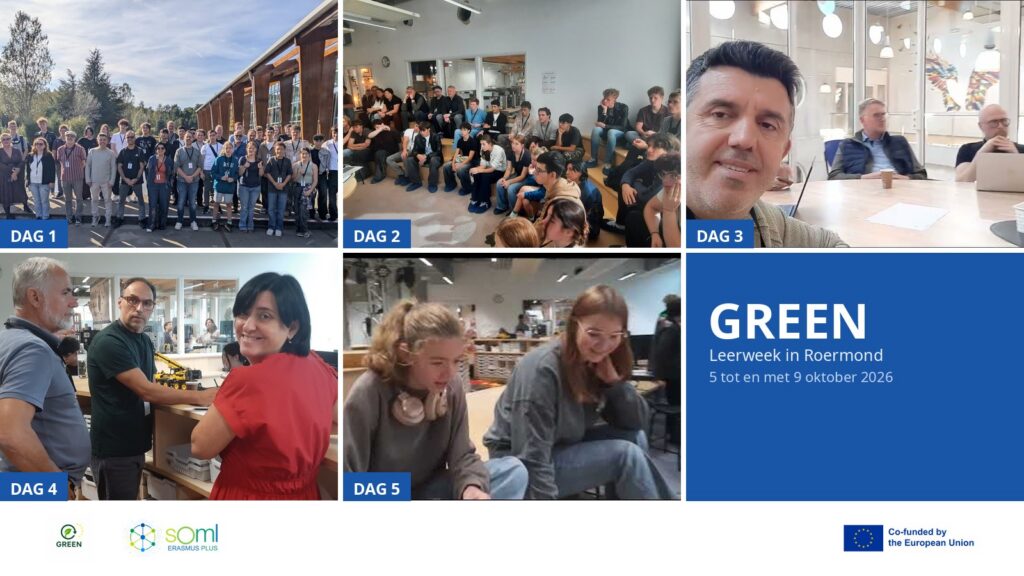
From 5 to 9 October, Roermond hosted the second Green Connection training. Students and teachers from Croatia, Iceland, Portugal, Türkiye and the Netherlands worked together for five days at Wings Agora, with SOML as host. One assignment ran through the week: build, in an international team, a working system that monitors plants and waters them by itself.
The teams combined a Raspberry Pi running Home Assistant with ESP8266 microcontrollers and sensors for temperature, humidity, light and soil moisture, plus a 12 V water valve. Every day started with a team meeting: where are we, who does what, which problem do we solve first.
The week, day by day
Turkish partner İTÜ MTAL filmed every day and published five daily videos.
- Day 1, Monday: getting to know each other and a visit to Botany B.V. at Brightlands Campus Greenport Venlo, where participants saw vertical farming at work and what lighting and climate control do to a crop. Watch the video (10 min)
- Day 2, Tuesday: hands on the hardware: wiring microcontrollers, reading sensors and collecting the first measurements. The day ended with an excursion to Fort Eben-Emael in Belgium. Watch the video (7 min)
- Day 3, Wednesday: a biology workshop at Wings Agora on how much light a crop needs, how long it takes to harvest and what that costs in energy. With that knowledge the teams set the threshold values for their automations. Watch the video (9 min)
- Day 4, Thursday: bringing all the parts together into one system, with automated watering and a dashboard that pulls everything together. Watch the video (7 min)
- Day 5, Friday: the teams presented their prototypes and showed live how they measure, alert and water. Watch the video (18 min)
Teachers among themselves
Alongside the building, the teachers took time to talk about their own education systems: how IoT and computer science fit into the Dutch curriculum, how vocational education is organised in the other countries, which software works and what role AI is taking in technical education. Each partner showed how the GREEN materials fit their own programme.
What stays behind
The prototypes travel back to the partner schools, where they will be connected to the vertical gardens built within GREEN. They are also the starting point for the next stage of the project. More about GREEN on the project page and at greenerasmus.com.